Returning to Dubai Design District from 4 to 8 November, Downtown Design brings together international names in design, regional studios, and a new generation of designers exploring what contemporary design means today. As the main event of Dubai Design Week, it welcomes brands such as Gaggenau and Venini alongside emerging talents from across the UAE. Yet some of this year’s most compelling work begins with details much closer to everyday life, revisiting familiar objects, family memories, and traditions that continue to shape the way we live.
Among the participants is family-owned gallery Iwan Maktabi, known for its rare rugs, textiles, and collectible design pieces. A regular presence on Dubai’s creative scene, the gallery is presenting new work this year by UAE-based designers Nadine Kanso and Omar Al Gurg. Although their approaches differ considerably, they share a common starting point: the details that give a place its identity, and the memories we attach to the objects around us.
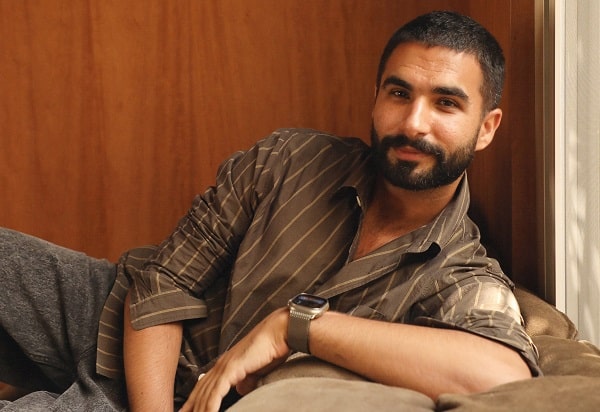
Image: Omar Algurg, Courtesy of Dubai Design Week
For Omar Al Gurg, the story begins at his grandfather’s house. The patterns for his LOOMA rugs draw inspiration from mirrors custom-designed for his grandfather’s majlis, built in the late 1970s. It is a personal memory, but rather than reproducing it literally in the rugs, Al Gurg distilled the mirrors’ patterns, stripping them of their finer details to give them a new form that could find a place in other homes.
“I have fond memories of my grandfather’s house, so we drew inspiration for the LOOMA rug patterns from the designs that adorned its mirrors. We reinterpreted these forms in an abstract, simplified way, turning a personal experience from our lives into something that can be shared with others,” Al Gurg says.
What we appreciate about this approach is that it does not attempt to recreate the past as it was. Instead, it takes one detail from it and gives it a new life. The memory remains present, but is no longer tied to a single house or a particular generation.
This idea becomes even more significant when we consider the majlis, which has never been simply a room filled with furniture. It is a space for welcoming guests, exchanging ideas, and connecting with others. As living arrangements change, not every home has a dedicated majlis, and families have adapted the way they use their spaces. Yet Al Gurg believes that what the majlis represents can endure, even when the setting itself changes.
“A rug is known for its ability to bring the elements of a space together, often becoming the focal point of a room when placed at its centre,” he says, noting that rugs are deeply rooted in the region’s heritage and that textile-making has a long history here. But another aspect interests him just as much: the way a rug can influence how a space is used.
“Even when furniture is present, people tend to gather closer together and sit near one another when the space encourages them to do so,” he explains.
It is a simple observation, but one that reveals how a design object can influence the way we interact with our surroundings. Furniture organises a space while also determining how it is used, whereas a rug allows greater freedom in the way people sit and connect with one another. Perhaps this is one of the majlis’s greatest strengths. Its significance lies less in the furniture it contains than in the opportunities it creates for people to interact.
When we asked Al Gurg which majlis traditions should be preserved and which could evolve, his answer was clear: “I believe everything that makes the majlis distinctive deserves to be preserved. There is something unique about the way people communicate and interact within this space, which lies at the heart of Emirati traditions.”
For him, the majlis is a place for sharing knowledge as much as it is a gathering space for family and friends, strengthening a sense of belonging from one generation to the next. Homes and lifestyles may change, but he insists that “the fundamental principles of the majlis should remain the same.”
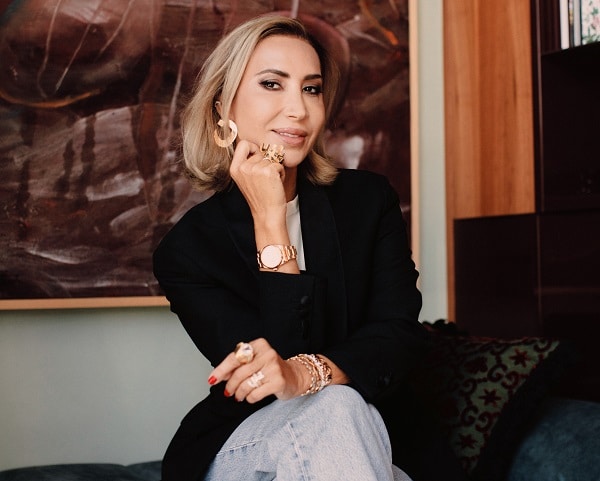
Image: Nadine Kanso, Courtesy of Dubai Design Week
Nadine Kanso approaches heritage from another angle, using Arabic calligraphy as her starting point. Having made Arabic letters central to her jewellery designs, where their personal and cultural meanings intertwine with the design itself, she now brings them into the world of rugs and textiles in collaboration with Iwan Maktabi, while also revisiting symbols associated with the UAE.
Moving from jewellery to textiles has required a different way of working with letters. In jewellery, structure, precision, and the relationship between the letter and the body are fundamental. A rug, however, has an entirely different presence. It becomes part of the space we inhabit, walk across, and return to every day.
In an exclusive interview with A7, Kanso says: “Working with textiles has allowed me to approach Arabic calligraphy differently, making it part of our everyday lives, something we live with, walk on, and interact with. In this way, the work becomes part of the home and of the memories created within it.”
Kanso seeks to take Arabic calligraphy beyond the confines of books and jewellery, bringing it into the spaces we inhabit. When letters move into a new medium, they do not lose their meaning. Instead, they acquire another dimension, opening up different ways for us to see and engage with them.
This question is particularly relevant today, as Arabic calligraphy appears across an increasingly wide range of fields, from brand identities to souvenir products. Its visual appeal is undeniable, but using it purely as a decorative element can separate it from the language and culture that give it meaning.
For Kanso, the difference lies in the intention behind its use. “My work has always begun with the meaning embedded in the letters, and with how to translate that meaning into a contemporary form without losing its essence,” she explains.
She is equally thoughtful about the symbols she incorporates into her work, seeing no need to include them all or bring every story together in a single piece. Leaving room for interpretation allows viewers to draw on their own associations and memories rather than directing them towards a fixed reading.
Nor does she expect viewers to be able to read Arabic to engage with her work. The rhythm of the script, the fluidity of the letters, and the way they intertwine all have, in her view, an expressive power that extends beyond the literal meaning of words.
“I hope people feel curious first, and that the experience might encourage them to discover more. Ultimately, my work is about making our cultural language accessible to everyone without simplifying it, and giving it the ability to connect generations and reach beyond the Arab world,” she says.
Through their distinct approaches, Nadine Kanso and Omar Al Gurg show that drawing on heritage in contemporary design does not require recreating it as it was, or treating it as a legacy that must be preserved at a distance from everyday life. The story may begin with a mirror in a grandfather’s house or an Arabic letter whose significance extends beyond its abstract form. What matters is finding a way for these elements to remain part of our lives in a new form.
This is what makes the conversation unfolding at Downtown Design worth paying attention to. The past is neither something to move beyond nor a fixed image to be repeated. Instead, it is a source to return to, rediscover, and give a place in our homes and contemporary lives.