Boghossian is participating in NOMAD Abu Dhabi for the first time, with the fair taking place from 18 to 22 November 2026. The Maison has joined forces with Ars Belga to present an exhibition entitled Light into Colour, bringing together high jewellery and painting in an artistic dialogue centred on light and colour.
The exhibition explores the role of light and colour in gemstones, with each painting paired with a piece of jewellery that interacts with it and reflects its character.
In this exclusive interview, Nicolas Boghossian, Head of Operations at the Boghossian headquarters and a partner at Ars Belga, tells us how each artist found their own way of making colour hold light. He also discusses the Maison’s approach to gemstones and its longstanding relationship with the region.
Gemstones have always been the starting point for Boghossian designs. How does placing your jewellery alongside paintings change the way you see a stone’s artistic potential?
Gemstones are usually the starting point of our designs, but when we place them alongside paintings, we also begin to see them as a medium for colour in their own right. A coloured gemstone is not a pigment; it is white light entering a crystal and emerging transformed. Painters spend their lives trying to make colour hold light, whereas a gemstone does this naturally. When placed beside a painting, the stone becomes more than a precious jewel. We also discover how it interacts with light, and that is where its artistic potential lies.
This interaction also encourages us to be bolder, whether by combining colours that rarely meet, playing with contrasts as much as we explore the harmony between different shades of the same colour, or creating a piece of jewellery in much the same way a painter composes the colours of a canvas. Our role, as a high jewellery Maison, is simply to give the stone the freedom to express itself.
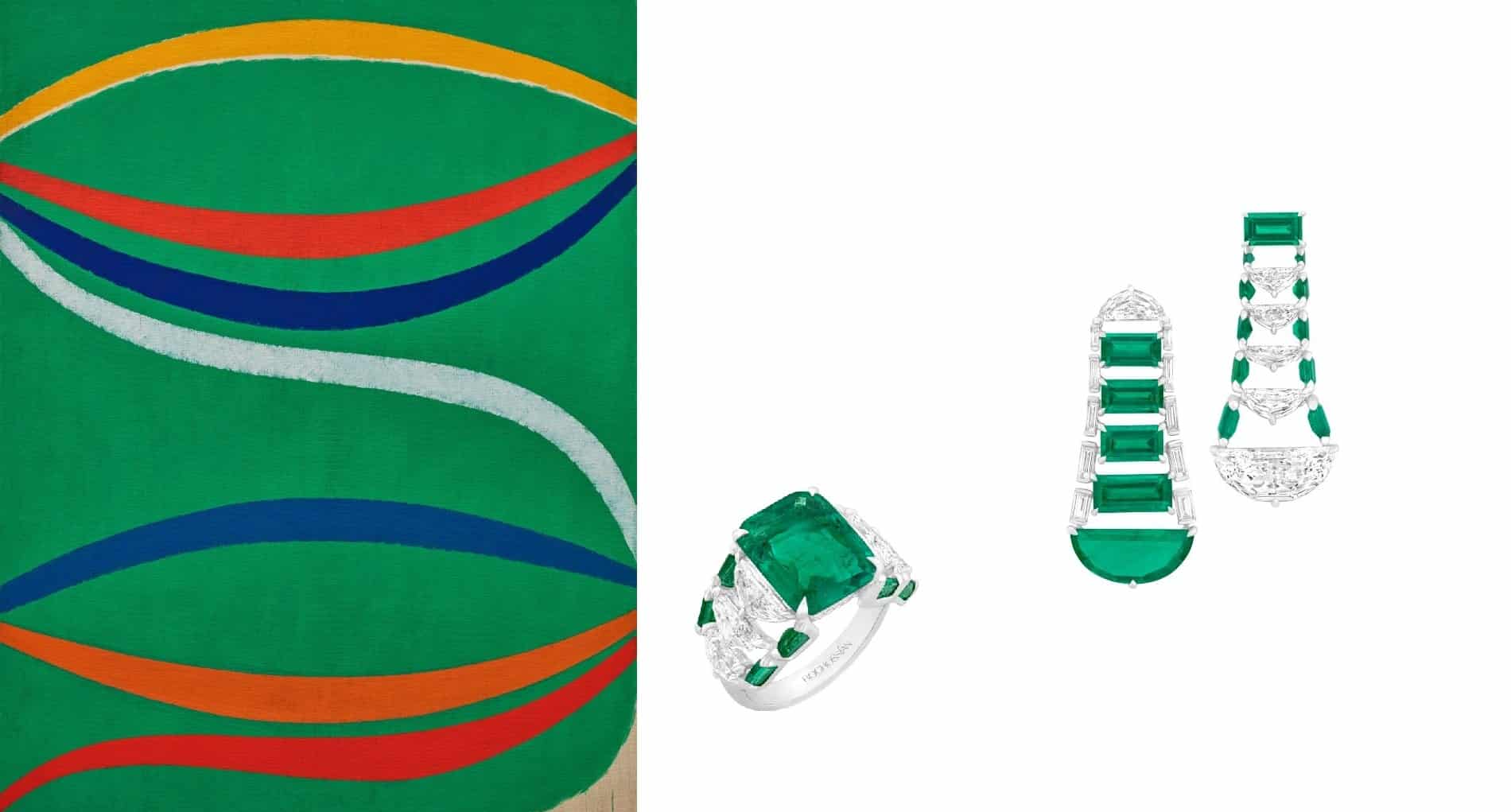
Images: Piero Dorazio, Green Horn, 1965
Light into Colour brings together artists with very different approaches to colour. What do these works have in common with Boghossian jewellery?
Beauty and creativity are the first things these works share, but light is the most important element. Each artist has found their own way of making colour hold light, whether through movement and luminosity, stillness, the changes it undergoes throughout the day, or by emphasising its texture and dimensions.
To build this dialogue, we created a sequence that unfolds over the course of an entire day, from the first rays of light until nightfall. Each painting is paired with a piece of jewellery that interacts with it and expresses it visually. In the works of Piero Dorazio, brushstrokes overlap and layers of colour accumulate, much like the way we layer gemstones. Amadeo Luciano Lorenzato, meanwhile, gives his colours a pronounced texture, something we found echoed in our Kissing ring, which brings together a diamond and a mint-coloured tourmaline.
Ultimately, the eye cannot always distinguish between colour created by a mineral and colour applied by a painter’s brush.
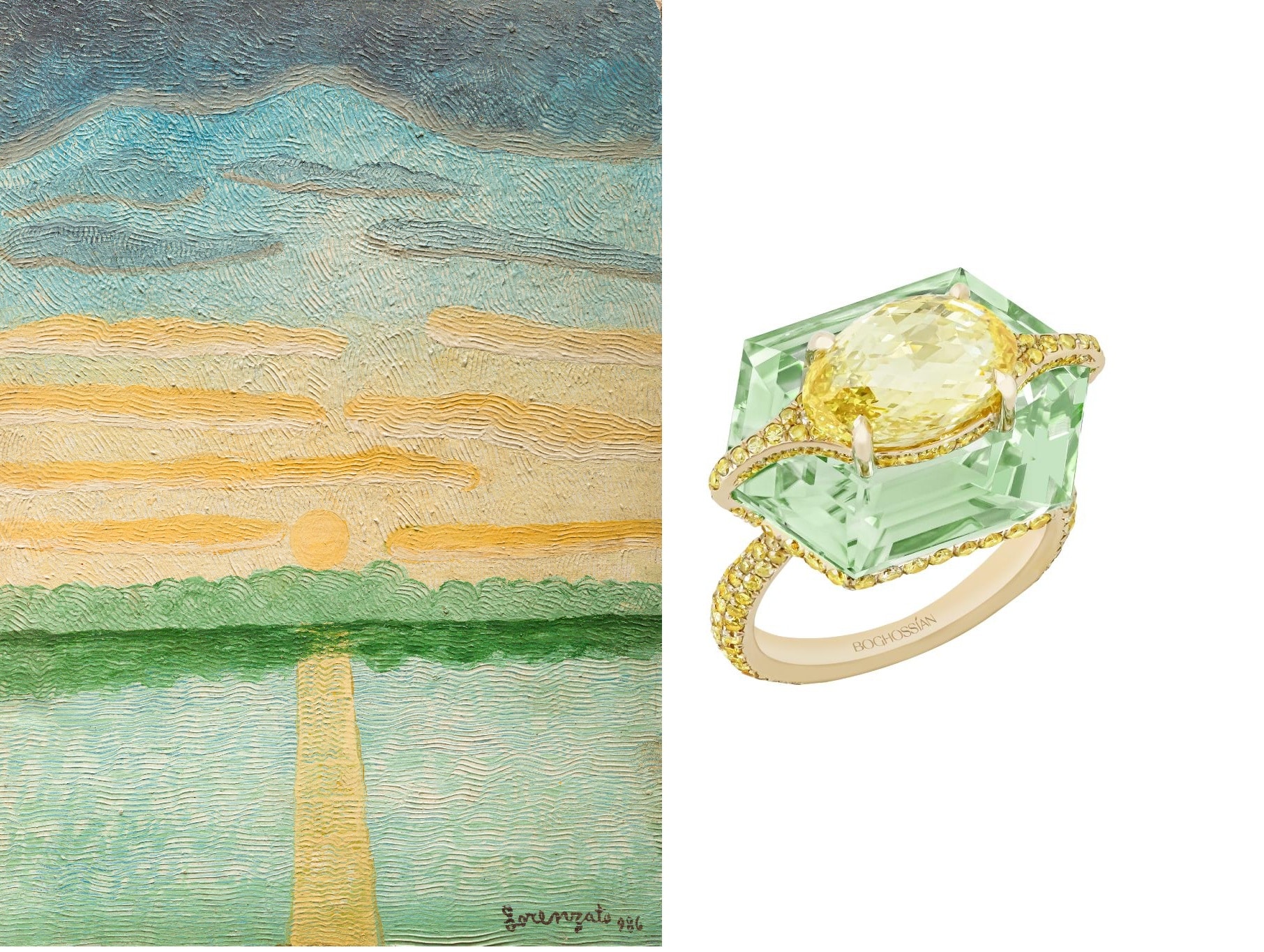
Images: Lorenzato, Untitled, 1986
Albert Boghossian describes jewellery design as drawing with light. When you look at a finished piece, what tells you that you have captured light in a way that goes beyond the beauty of the gemstones themselves?
That happens when the piece begins to interact with the light around it, almost as if it has come alive. The colour of a gemstone is never truly constant. It appears warmer under candlelight, cooler in daylight and deeper as night falls.
At NOMAD, the pairings of paintings and jewellery reveal this particularly well. Some paintings seem as though the piece displayed beside them was the artist’s direct source of inspiration, or vice versa. At that point, the piece moves beyond the beauty of its gemstones, and art and jewellery seem to speak the same language: the language of colour.
The colour of a gemstone is influenced by light, its mineral composition and the way it is cut. How do you balance these natural characteristics with a designer’s desire to create something unexpected?
The colour of a gemstone comes from nature. Copper gives Paraíba tourmaline its vivid, electric blue, while chromium is responsible for the green of emeralds and the red of rubies. Iron, meanwhile, can give gemstones yellow tones.
Our role is to respect each stone’s natural characteristics and choose the cut and setting that best bring out its beauty. The element of surprise comes from the way we combine colours and set the stones. Take, for example, our mismatched earrings, where a Paraíba tourmaline set within turquoise meets a diamond set within labradorite. They are two different voices that find harmony through contrast.
Boghossian is known for innovative techniques such as Art of Inlay and Kissing. How do these innovations challenge traditional approaches to gemstone setting and the way jewellery is worn?
Minimising the use of gold is part of the Maison’s identity. We are constantly looking for ways to free the stone and bring it to the forefront of the design, allowing light to reach it from every direction.
Our three signature techniques all stem from this philosophy. Art of Inlay, whose roots go back centuries and which we have reinterpreted in our own way, involves cutting one gemstone and setting it within the body of another. Kissing, meanwhile, involves setting one gemstone on top of another in an interaction that resembles an embrace, allowing each stone to enhance the colour of the other.
Our patented Merveilles technique sets the gemstones from every direction within an almost invisible structure, making them appear as though they are suspended in the air. When worn, these pieces feel exceptionally light.
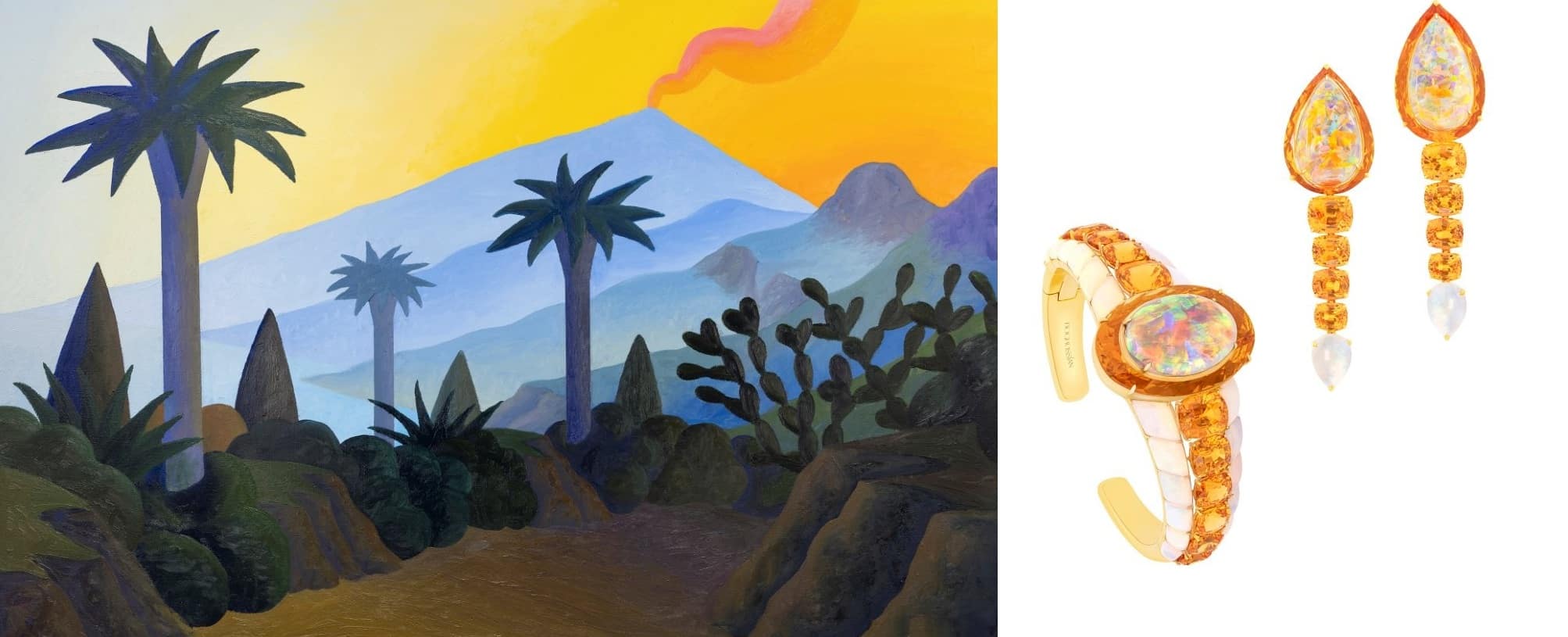
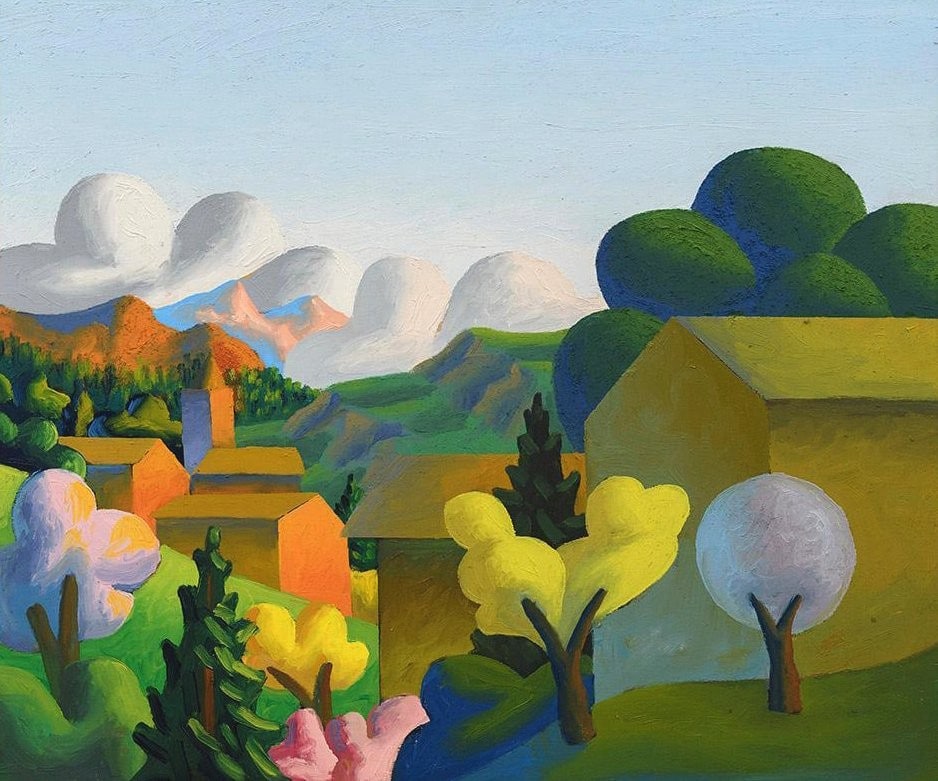
Images: Salvo, Vulcano, 1992, Oil
Why was NOMAD Abu Dhabi the right setting for this collaboration? And what does presenting high jewellery within an exhibition dedicated to art, design and collectible objects make possible that might not necessarily be explored in a traditional jewellery exhibition?
NOMAD felt like a natural choice. We have built a strong relationship with the region over the years, so making our first appearance at the exhibition in Abu Dhabi was a particularly meaningful step for us. Our stand also reflects the character of the region. We used hand-brushed paper, whose curves and colours evoke the sand dunes of the UAE.
Art is an essential part of the Maison’s creative spirit, and this exhibition gives us an opportunity to express that side of our identity in a new way. By placing our jewellery in direct dialogue with paintings, we can explore the ideas of colour and light through their interaction.
Through Ars Belga, this collaboration also draws attention to artists who have not received the recognition they deserve in art history. To what extent can a jewellery Maison help shape how artworks are discovered and remembered?
Art has always been part of our family history, through the Boghossian Foundation and Villa Empain in Brussels. My father introduced me to both the worlds of jewellery and art, and I have remained active in the art scene alongside my work within the family Maison ever since.
Through Ars Belga, which specialises in contemporary art and post-war art, my business partner Vincent Matthu and I share a passion for rediscovering artists who have not received the attention they deserve. Bringing these two worlds together was a project we had wanted to realise for a long time.
Our role is not to rewrite art history, but to introduce a new audience to these artists and their work. The dialogue with our jewellery helps make this possible: a piece can become an entry point for discovering a painting, while the painting offers us a new way of looking at a piece of jewellery.