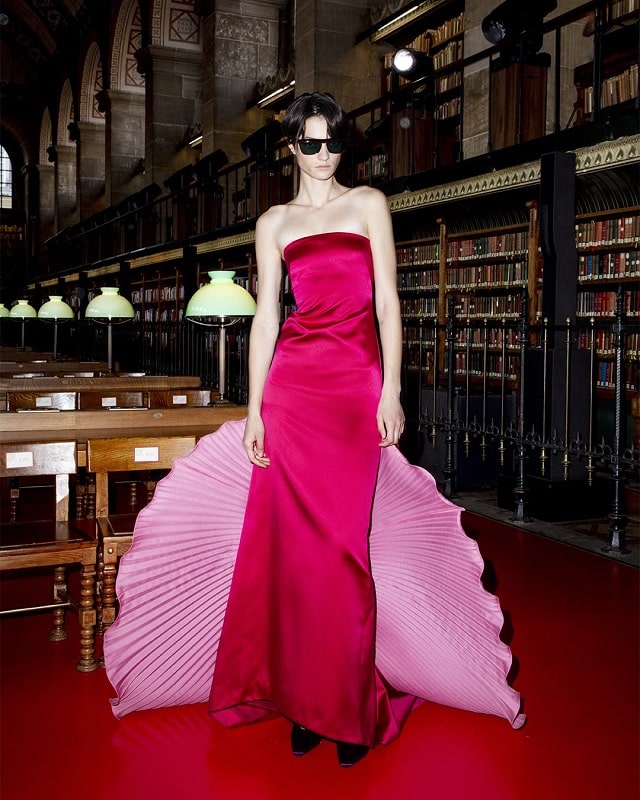
Almost every reader has a shelf they mean to return to. A novel bought in a moment of enthusiasm, a book that demands more concentration than they can currently spare, another waiting for a question they have not yet thought to ask. Sometimes a book stays unopened until something in our lives makes us ready to read it.
It was this idea of unread books that Alessandro Michele brought to Valentino’s Spring/Summer 2027 collection, Antibiblioteca, presented at the Bibliothèque Sainte-Geneviève in Paris. The reference comes from Lebanese-American writer and thinker Nassim Nicholas Taleb, and his thinking about the books we have yet to read turns out to say a good deal about fashion.

Image: courtesy of Valentino
In The Black Swan, Taleb discusses the personal library of Italian writer Umberto Eco, which contained around 30,000 volumes. For Taleb, the library’s value lay as much in the books Eco had not read as in those he had: the knowledge still waiting for him beyond what he already understood. Taleb calls this collection of unread books an “antilibrary.”
The idea belongs to his wider exploration of uncertainty and the limits of knowledge. In books such as Fooled by Randomness, The Black Swan and Antifragile, Taleb questions our confidence in our ability to explain and predict the world. His antilibrary reminds us how much there is still to learn, even when we believe we know a great deal.
Where Stories Begin
Stories often start with fragments whose purpose is unclear: an image, a gesture, a sentence overheard by chance and remembered. A character can remain indistinct for months before a small detail gives them life. These possibilities take time to develop, and sometimes the ones worth keeping are those we cannot immediately explain.
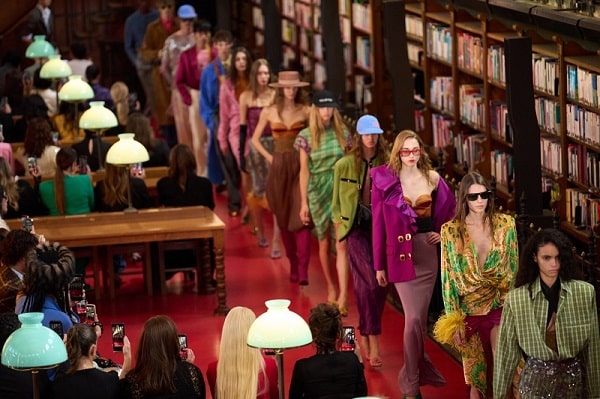
Image: courtesy of Valentino
An unread book holds a similar tension. We see its title and feel its weight, but its effect on us remains unknown. It might change how we understand an experience, or lead us to another book entirely.
Why we acquire books also matters. The impulse might come from a love of reading, a desire to possess or an image we wish to project. What interests me is the moment a book moves from the shelf into our thinking, when something we have owned for years finally finds its place in our lives.
From Shelf to Runway
Michele draws on Taleb’s passage in his notes for Antibiblioteca. The connection is explicit. He considers how garments, like unread books, keep their value beyond their immediate use, writing that even the clothes we will never wear “still speak to us of the lives we could have lived.”
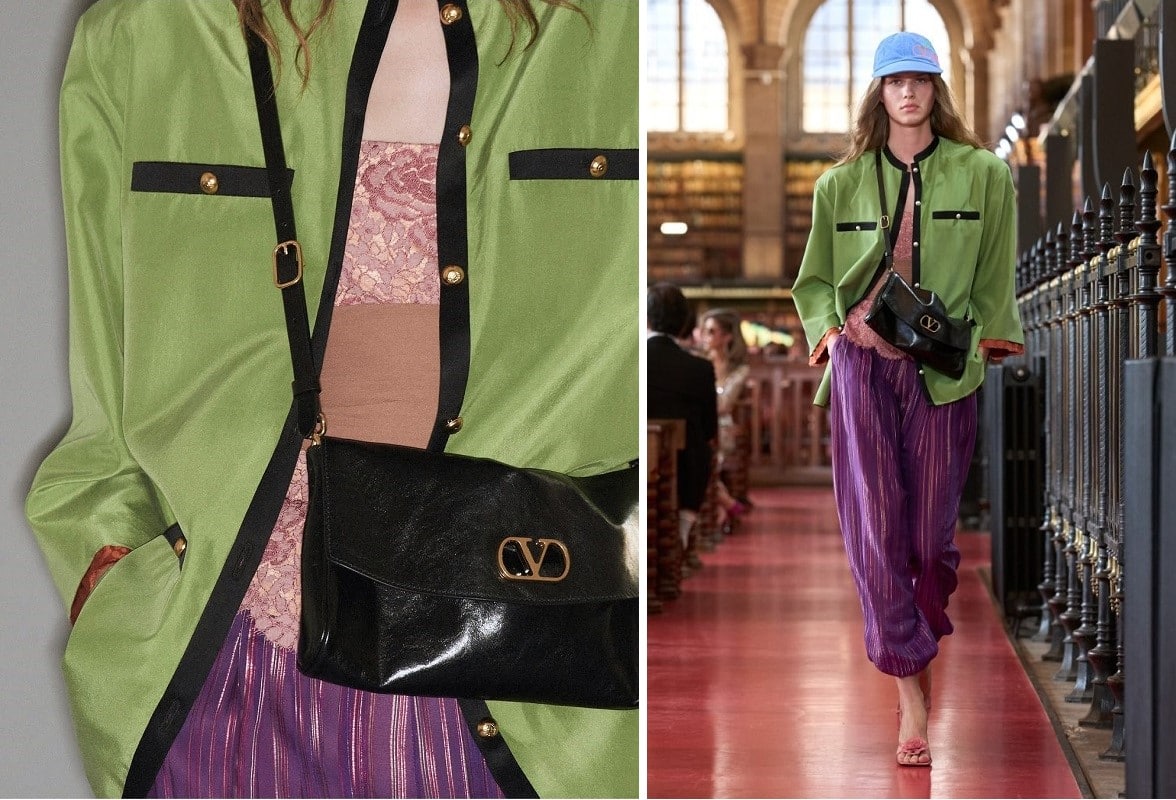
The clothes give that idea a tangible form. One look early in the show caught my attention: a green jacket with pronounced shoulders and gold-toned buttons, paired with close-fitting mauve lace shorts that ended above the knee. The structured volume of the jacket met the delicacy of the lace and its closeness to the body, bringing the formality of tailoring together with a sporty cut.
Images: courtesy of Valentino
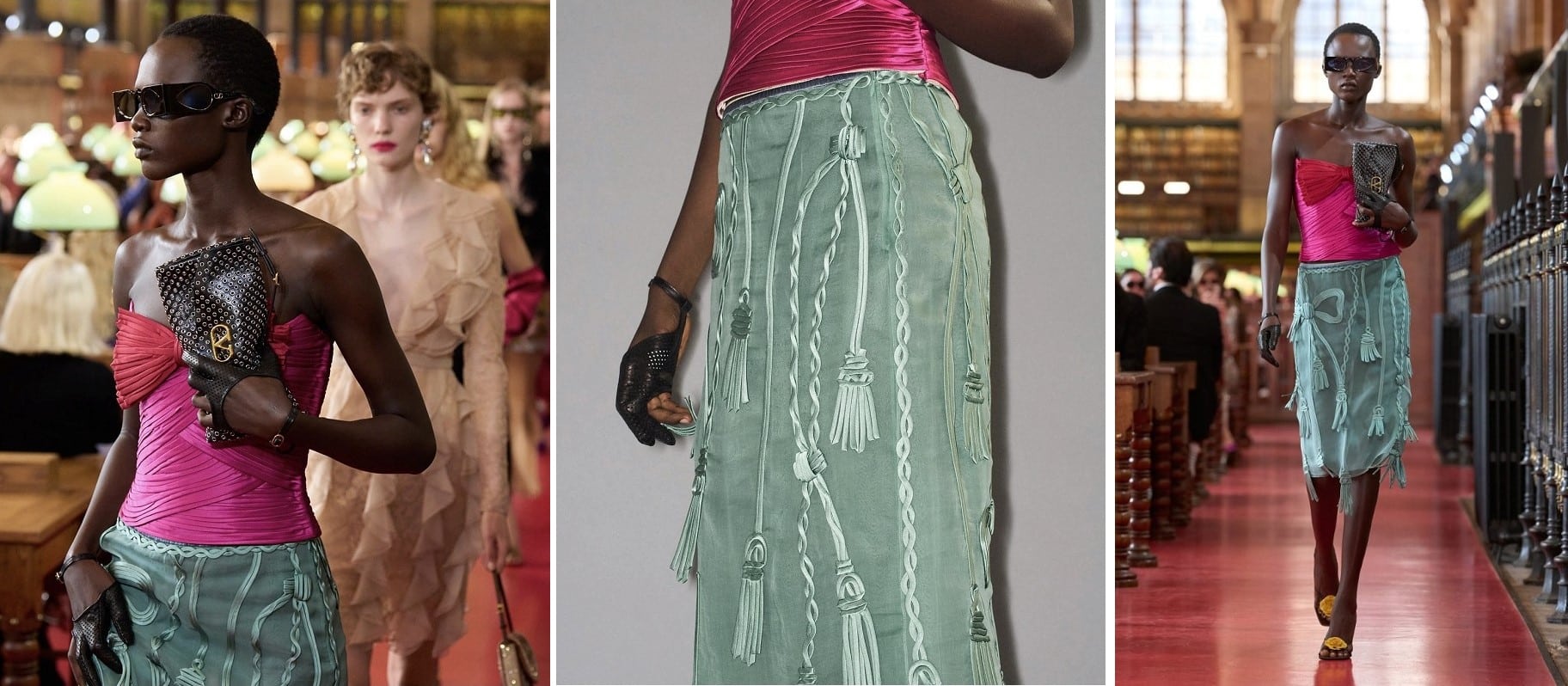
In the following look, a vivid fuchsia satin bustier was paired with a fitted green knee-length skirt, its glossy surface interrupted by a feathered hem. The bustier’s defined edges and the narrow line of the skirt kept the silhouette controlled, while the feathers gave it movement at the hem.
For me, these combinations suggest different characters. A jacket might convey composure until the piece worn with it unsettles that first impression. A garment can be the beginning of a character, offering a first glimpse and leaving us to imagine the contradictions and the life behind it.
Images: courtesy of Valentino
Clothes can tell us how someone wishes to be seen, what they might want to conceal or even how they are feeling on a particular day. A carefully chosen outfit and a garment pulled on without much thought tell two entirely different stories.
How Does a Fashion Show Tell a Story?
A fashion show gives these possible characters an order and a duration. An early look sets expectations; the next might repeat its shape while changing its mood. Recurring colours and proportions create connections, much as recurring images do in a novel.
The pace of the walk decides how long we spend with each character. Music changes how we read a look, and at Valentino, Troye Sivan’s “Party” played on loop through a library emptied of readers and lit with strobes.
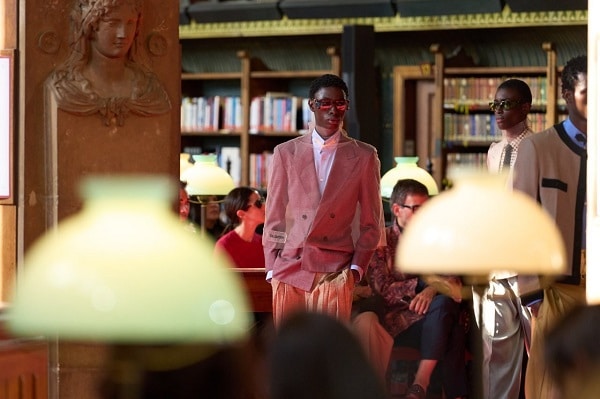
Image: courtesy of Valentino
The setting was central to the experience. Michele asked guests to bring a book to donate, taking the antilibrary beyond the collection itself. Between the shelves, the looks appeared briefly, leaving us to imagine what came before their arrival and what might follow.
In a novel, one sentence about the way someone moves can be enough to suggest an entire life. On a runway, the colour and cut of a garment, and the way it moves on the body, can do the same.
Imagination and Ownership
The comparison gets more complicated when we reach the question of buying. An unread book remains available for study. An unworn garment may hold the value of its craftsmanship, a memory or a sense of pleasure, but its presence alone does not guarantee discovery. The promise of a possible version of ourselves can also be a persuasive reason to keep buying.
There is a difference between what a collection makes us imagine and the decision to purchase it. A look might suggest a character, or make us reconsider a colour or cut already in our wardrobe. We don’t need to own a piece for it to stay with us.
Luxury fashion makes this distinction particularly relevant. A collection reaches many people through images who will never buy its clothes, yet their encounter with it can still have creative value. If Michele’s idea holds, that value exists whether or not anything is sold.
Taleb’s antilibrary and Michele’s interpretation also differ. Taleb is concerned with the knowledge we have yet to acquire and the limits of what we understand. Michele takes that possibility into the imagination, to the lives a garment might suggest before anyone has worn it.
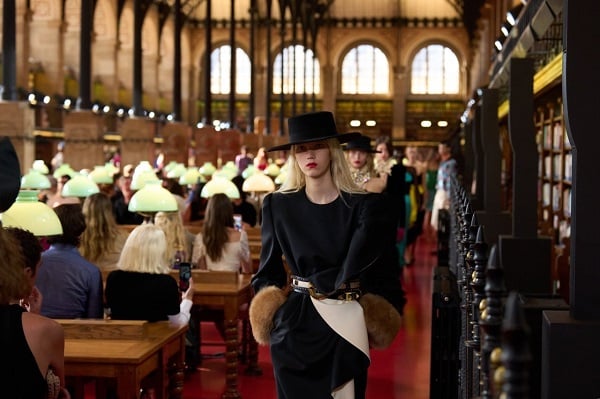
Image: courtesy of Valentino
His collection gives us a contemporary reason to return to Taleb, whose question reaches well beyond the runway: how do we stay open to what we have yet to understand?
Think of the books waiting on our shelves. Some may remain unread, while others will find their moment and change the way we see a subject, a person or even ourselves. The appeal of the antilibrary lies in finding something we never thought to look for.