There is something about the end of summer that invites reflection. After months of dinners, late nights and conversations, some fleeting, others that stay with you, the arrival of a new season has a way of bringing certain moments back into focus. The things you said, the things you did not, and the words that only came to you once it was too late to say them.
The new single from Lebanese singer-songwriter Dana Hourani, Badkon Shi?, arrived in that space for me. Quiet and deliberately intimate, it transported me somewhere still. I found myself thinking about conversations I had over the summer and others from much further back.
That is what makes the song so relatable. It is personal to Hourani, but leaves enough room for us to find our own memories within it.

Image: Courtesy of Dana Hourani
“The song actually started with the idea of a final conversation that kept replaying in my mind,” Dana Hourani tells A7. “All the things I would ask someone if I had known it was the last time I was going to see them.”
There is a particular ache in thinking of the perfect question, response or confession only after a moment has become unreachable. Badkon Shi?, which translates loosely as “Do you want anything?”, captures that feeling without trying to resolve it. The question is ordinary, almost casual. In the context of a final conversation, it suddenly carries everything that was left unsaid.
What I loved about the song is that Hourani never tells us exactly who, or what, we should be missing.
“It started bringing up memories of my childhood, my family, Lebanon, and especially the South,” she says. “I think at its core it’s really about longing, and how sometimes you don’t realize how much a person, a place or a time meant to you until you can’t go back to it anymore.”

Images: Courtesy of Dana Hourani
Listening to it, loss begins to feel less like a single event and more like something constantly shifting around us. People leave, but so do places as we remember them. Friendships change. Childhood homes disappear. There are versions of ourselves that we can recall perfectly but could never inhabit again.
“I never wanted to tell people what they were supposed to be missing,” Hourani explains. “Loss is much broader than losing a person. You can miss a place, a version of yourself, a home, a period of your life. You can even miss something that still exists but doesn’t exist in the same way anymore.”
That openness is what allows Badkon Shi? to become more than Hourani’s memory. There is space inside the song for the listener’s own unfinished conversations, and for those small exchanges we did not realise would become significant until much later.
With lyrics by Robert Al-Asaad and Hourani, composition by Al-Asaad and production by Sleiman Damien and Hourani, the track resists turning those emotions into something overly dramatic. Intimate vocals sit among layered harmonies, while the oud brings warmth to the soft, ethereal production. Nothing is pushed too far. Instead, the song seems to hover, much like a memory that returns unexpectedly and disappears before you have quite worked out why it came back.
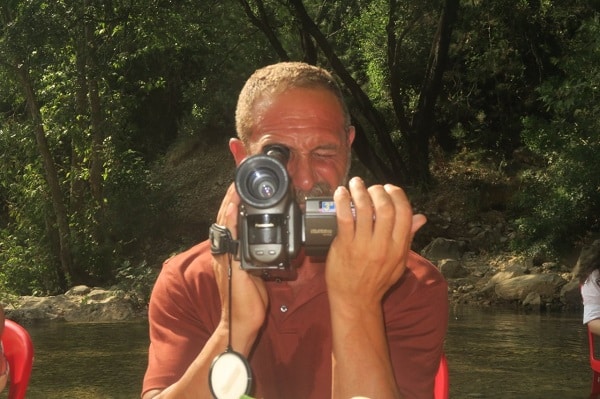
Image: Courtesy of Dana Hourani
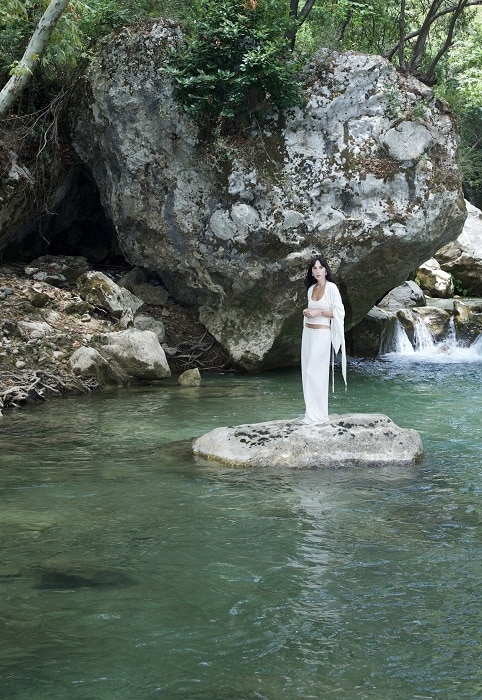
The accompanying film, directed by Mikella Younes and produced by Aya Ghosn, takes that relationship with memory somewhere more literal. Hourani returns to one of her most cherished childhood experiences, family days beside the Litani River in South Lebanon. Drawing from her own photographs and home videos, the film moves between archive and recreation, past and present.
“I didn’t want to invent a world around the song. I wanted to go back to a real one,” Hourani says. “We recreated moments from old family photographs and videos and brought it all into the film as well.”
There is something moving about trying to physically reconstruct a memory when you already know it can never truly be recreated. It becomes even more personal when Hourani’s daughter appears as a younger version of her mother.

Images: Courtesy of Dana Hourani
“Having my daughter portray me when I was her age made the whole thing feel incredibly full circle,” she says. “It became less about making a music video and more about bringing a memory back to life for a few minutes.”
The Litani River is more than a beautiful backdrop. With access to places in South Lebanon changed by the situation in the region, the landscape gives the song’s ideas about memory a physical form. A place can still exist on a map while the version of it that belongs to you becomes impossible to reach.
It is one of the stranger parts of growing older. We accumulate more memories while becoming increasingly aware of how temporary the circumstances around them were.
“When you’re younger, memories are just memories. You don’t really understand their value because you’re busy living and assuming there will always be more of everything,” Hourani says.
“Especially with Lebanon, there are places and moments I remember exactly as they were, even though I know I can never really return to them in the same way. I think I hold onto things more now. Not because I want to live in the past, but because I understand what it means to have had them.”
That thought stayed with me. So much of Badkon Shi? looks backwards, but it never feels nostalgic for nostalgia’s sake. If anything, the song made me think about paying closer attention to the present. The dinner you are sitting through, the story you have heard before, the person across from you. We rarely know which ordinary moments will later become the ones we want to revisit.

Image: Courtesy of Dana Hourani
When I asked Hourani what she would do differently if she were actually given the final conversation imagined in the song, her answer was strikingly simple.
“I think I would speak less and listen more.”
“When you’re younger, you always think there will be another chance. Now I think I’d just want to sit there a little longer and hear everything, be fully present. The stories, the small details, even the things that felt insignificant at the time. Those are somehow the things you end up wanting back the most.”
It is difficult to hear that without considering your own answer.
Badkon Shi? also marks a return for Dana Hourani after a year and a half away from releasing music. Rather than announcing that return loudly, the new single feels inward-looking, and more assured for it.
“I think I’m stripping away a lot of the noise,” Hourani says. “I’ve always made music that feels personal to me, but right now I trust my instincts more and I feel less of a need to explain them.
That instinct runs through Badkon Shi?. Hourani never identifies exactly who is being missed or asks the listener to arrive at the same memory she did. By the end, I was back at those dinners and conversations from the summer, thinking less about what was said than the small details around them. The things that felt ordinary enough not to notice at the time.
Badkon Shi? Credits
Artist: Dana Hourani
Lyrics: Robert Al-Asaad and Dana Hourani
Production: Sleiman Damien and Dana Hourani
Composition: Robert Al-Asaad
Music Video Director: Mikella Younes
Music Video Producer: Aya Ghosn