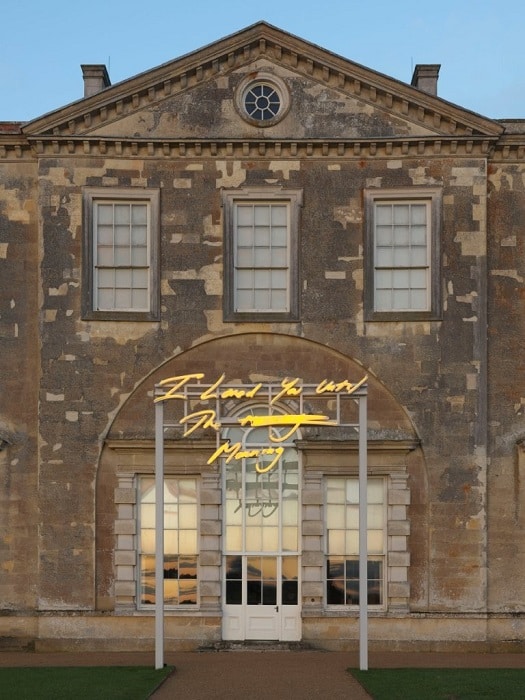
The drive from London takes just over two hours. Once the city begins to fall away, the roads narrow through the Buckinghamshire countryside, passing hedgerows, open fields and small villages. By the time Claydon House comes into view, the journey already feels part of the visit.
From the outside, the house gives little indication of what lies within. Home to the Verney family since 1620, Claydon reached its grandest expression in the eighteenth century, when Ralph, 2nd Earl Verney, embarked on an extravagant rebuilding project intended to display the family’s wealth and political ambition.Although only around a third of his original house survives today, its remarkable Rococo interiors still reflect four centuries of the family’s history.
The exhibition unfolds naturally through the house before continuing into the grounds. Rather than following a conventional gallery route, visitors move from one room to the next, discovering how each artwork responds to its surroundings.

© Enrico David. Photo © White Cube (Theo Christelis).
The first encounter comes in Black & White Hall, where Enrico David’s Aurora stands beneath the soaring ceiling. Its upward gaze draws attention to the architecture above.

© Cai Guo-Qiang. Photo © White Cube (Theo Christelis).
In the Saloon, Cai Guo-Qiang’s five-panel gunpowder painting Heaven Complex No. 1 and No. 2 hangs alongside portraits by Van Dyck. On the day of my visit, live piano music filled the room, giving the formal setting an unusual tension, while the work’s vivid colours appeared almost celebratory.
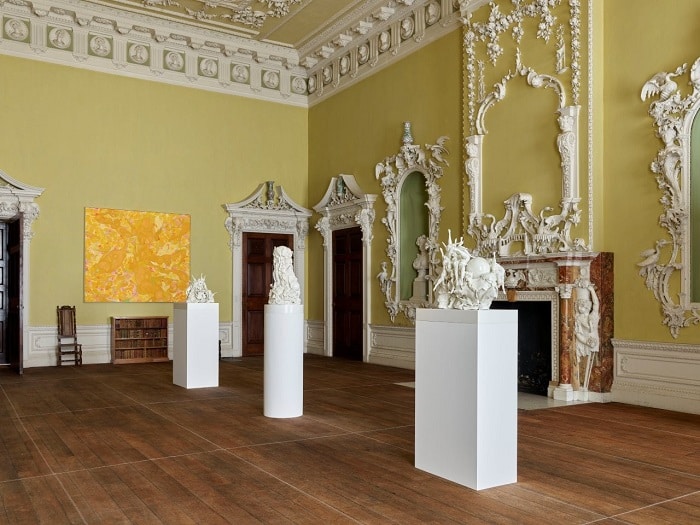
© Rachel Kneebone. Photo © White Cube (Theo Christelis).
In the North Hall, Rachel Kneebone’s porcelain sculptures sit among the Rococo ornament, their intricate forms echoing the room’s elaborate carvings.

© Mona Hatoum. Photo © White Cube (Theo Christelis).
Mona Hatoum’s Hair Necklace (silver) is shown in Florence Nightingale’s former bedroom. Nightingale’s sister, Parthenope, married into the Verney family, and the work’s small scale suits the intimacy of the room.

© Anselm Kiefer. Photo © White Cube (Theo Christelis).

© Marguerite Humeau. Photo © White Cube (Theo Christelis).

© Antony Gormley. Photo © White Cube (Theo Christelis).
Outside, the exhibition continues across the grounds. In the Fernery, Anselm Kiefer’s Rapunzel sits inside a glass vitrine surrounded by plant life. Marguerite Humeau’s Rise stretches across the pool garden, while Antony Gormley’s BIG CLASP stands at the end of the yew avenue. At the far end of the lawn, Theaster Gates’s bronze vessels stand where the 2nd Earl had All Saints’ churchyard removed to open the view beyond.

© Anselm Kiefer. Photo © White Cube (Theo Christelis).
Presenting contemporary art beyond museums and commercial galleries is hardly new, and country houses have become familiar exhibition sites. Yet Claydon’s particular history is present in every room. Contemporary works are seen alongside Van Dyck portraits, Rococo carvings and traces of four centuries of Verney family life. There is none of the compressed urgency of an art-fair booth or the crowded rhythm of an opening. Moving through the house and grounds takes time, and the works benefit from it.
By the end, it is difficult to separate the exhibition from Claydon itself. Works by familiar artists look different here, seen at the pace of a house rather than the pace of the art world.

© Theaster Gates. Photo © White Cube (Theo Christelis).
White Cube at Claydon runs at Claydon House, Buckinghamshire, until 14 September 2026.